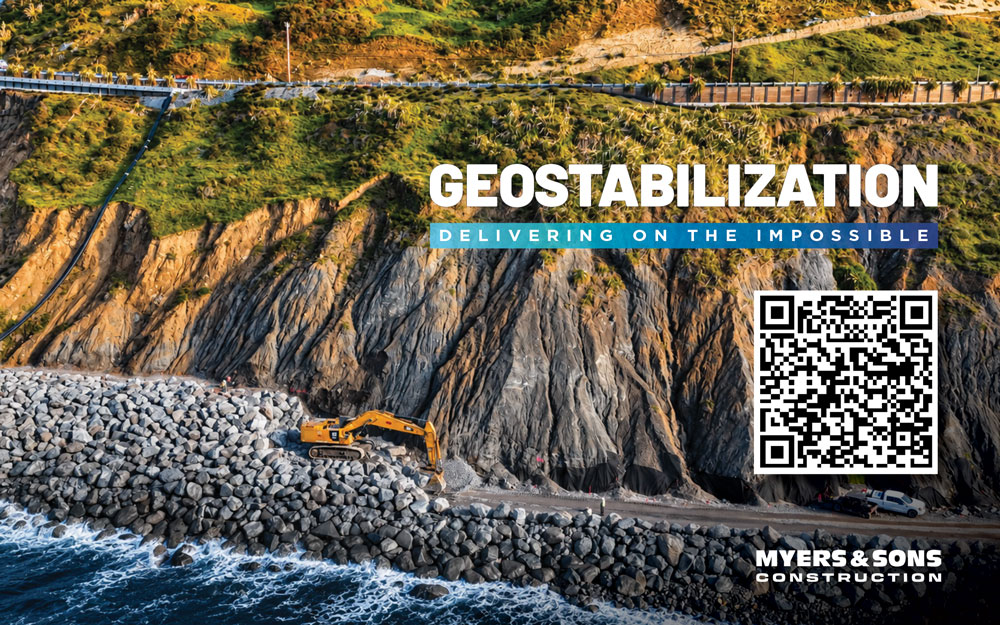
From unstable rock faces and failing slopes to terrain inaccessible by conventional equipment, Myers delivers specialized geostabilization solutions backed by the resources and field expertise of a proven heavy civil contractor.
We combine specialized equipment, difficult-access capabilities, and constructability-driven execution to stabilize slopes, mitigate geohazards, restore access, and protect the infrastructure and people below.
ROCKFALL MITIGATION
Control the Hazard
- Anchoring Systems
- Debris Flow Barriers
- Drapery Systems
- Pinned Mesh Systems
- Rock Scaling
- Rockfall Attenuator
- Rockfall Canopy
- Rockfall Protection Barriers
SLOPE STABILIZATION
Strengthen the Ground
- Drainage Improvements
- Erosion Control
- Slope Grading
- Retaining / Stabilization Systems
- Revetment
- Slide Repair
- Soil Nails / Rock Anchors
- Soldier Pile Walls
SPIDER EXCAVATION
Reach the Unreachable
- Emergency Response
- Difficult-Access Excavation
- Drainage + Ditch Work
- Drilling Capabalities
- Material Handling
- Rockfall + Slide Cleanup
- Scaling + Debris Removal
- Slope Preparation
Rockfall Mitigation
Engineered Protection between the Slope and What Matters
Myers provides specialized rockfall mitigation for steep, unstable, and difficult-access slopes where falling rock threatens highways, structures, workers, and the traveling public. Our teams combine heavy civil construction expertise with specialized access, excavation, scaling, and containment systems to address hazards at the source and control material as it moves downslope.
Depending on slope geometry, geology, rock size, and potential fall paths, Myers can install wire mesh, draped mesh, and cable net mesh systems designed to contain, redirect, or control falling rock. Draped systems conform to irregular rock faces and guide loosened material toward controlled collection areas, while higher-strength cable net systems provide additional capacity for larger rockfall hazards. These systems can be integrated with scaling, rock removal, anchors, drainage, and other stabilization measures to create a comprehensive solution tailored to site conditions.
Caltrans SR 140 Ferguson Rockslide Restoration CMGC
Rockfall Mitigation Mariposa County, California
Myers demonstrated this capability on Caltrans’ Ferguson Slide CMGC Project, left, along SR 140 near Yosemite National Park, one of California’s most challenging rockfall environments. Working within an active slide zone, the Myers team performed large-scale talus removal and helped install cable net drapery to minimize additional rockfall before construction of the permanent rock shed. Caltrans reports that Phase 1 ultimately removed 320,000 tons of material, installed 22 rock drains, and incorporated real-time slide monitoring and remote-controlled equipment to manage the extraordinary hazards of the site.
The work required scaling overhanging boulders and large rock outcroppings using heavy equipment and controlled methods while operating beneath an active rock face.
From targeted mitigation to major corridor recovery, Myers brings the equipment, field expertise, and heavy civil resources to control unstable slopes, contain falling rock, and protect the infrastructure below.
Slope Stabilization
Stabilizing the Ground. Protecting What Depends on It
Myers delivers slope stabilization solutions for unstable ground, landslides, erosion, and infrastructure threatened by changing soil, rock, groundwater, and environmental conditions. Our approach addresses the forces driving instability—from groundwater within the slope and loss of support at its toe to movement affecting the roadway or structure above.
Solutions can combine rock revetments, retaining systems, ground anchors, drainage, erosion protection, excavation, and slope reconstruction to address site-specific conditions. Rather than treating individual symptoms, Myers brings these measures together as an integrated construction strategy—control the water, reinforce the slope, protect the toe, and preserve the infrastructure above.
Caltrans Westport Landslide Emergency Project
Slope Stabilization Blues Beach, California
Myers is demonstrating this capability on Caltrans’ $110 million Westport Landslide Emergency Project along SR 1 in Mendocino County, right, where an active landslide and continuing Pacific Ocean erosion threaten the coastal highway. The project requires stabilization measures extending from the roadway to the shoreline, all while maintaining access along this critical coastal corridor.
At the shoreline, Myers is placing approximately 190,000 tons of rock revetment at the toe of the slope to protect against continued wave erosion. Above, crews are extending the soldier pile ground anchor wall to support the roadway foundation. Horizontal and subsurface drainage systems address another driver of instability by removing groundwater from within the slope and helping slow landslide movement.
Together, these systems demonstrate the comprehensive nature of Myers’ slope stabilization capability: protecting the toe, managing groundwater, reinforcing the ground, and supporting the roadway above.
Spider Excavation
Accessing the Terrain Conventional Equipment Cannot
Myers’ spider excavation capability takes heavy construction beyond the limits of conventional equipment, providing a specialized solution for steep, unstable, irregular, and access-constrained terrain. With independently articulating legs and wheels, exceptional ground clearance, and a highly maneuverable boom, spider excavators can establish stable working positions on severe slopes and rugged ground—putting excavation power precisely where it is needed.
This capability is particularly valuable for slope stabilization, rockfall mitigation, scaling and debris removal, slope preparation, drainage improvements, emergency response, and work within environmentally sensitive areas. By reducing the need to construct extensive temporary access roads or working platforms, spider excavation can also minimize site disturbance, accelerate mobilization, and provide greater flexibility as changing field conditions are encountered.
County of Placer, American River Debris Removal Project
Spider Excavation Auburn, California
Myers demonstrated this capability on the American River Debris Removal Project, left, where crews faced steep canyon access, unstable terrain, an active river, environmental restrictions, and bridge debris buried beneath nearly 60 years of sediment. A spider excavator was specifically selected for its ability to traverse the canyon’s steep and irregular terrain, supporting excavation and exposure of submerged structural elements so they could be cut, rigged, lifted, and removed.
The operation ultimately removed approximately 450 tons of steel and 600 cubic yards of concrete, helping eliminate a hazard that had remained in the American River for six decades.
Backed by Myers’ heavy civil resources, specialized equipment, and experienced field teams, spider excavation gives us the ability to bring the equipment to the problem— rather than forcing the terrain to accommodate the equipment.
Myers & Sons Construction is proud to announce the launch of our new GeoStabilization Division, expanding our capabilities to deliver specialized solutions for some of the most challenging terrain and site conditions.
Explore our new interactive GeoStabilization brochure to see our capabilities, specialized equipment, and the heavy civil experience behind our newest division.